Our Inspiration
Inspired by the Unfathomable Mercy of God, we are here to pray the chaplet for poor sinners with the faith that Jesus will apply His Grace and Mercy to those in most need.
“My mercy is greater than your sins and those of the entire world.” (1485)
The Chaplet of the Divine Mercy and the promises given to St. Faustina.
“When they say this chaplet in the presence of the dying, I will stand between My Father and the dying person not as the just judge but as the Merciful Savior.”
Yes, you might say, but the person that I want to pray for is dead. We then look to the venerable Padre Pio and this:
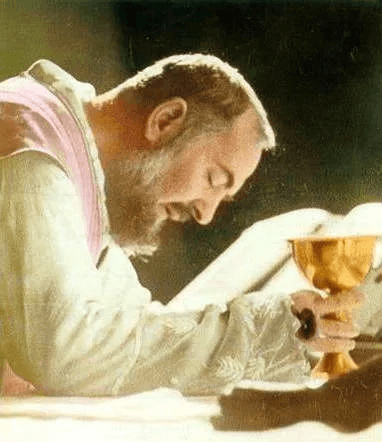
Padre Pio was once being examined by a doctor who noticed that the friar was quietly praying. Curious, the doctor asked him for whom he was offering his prayers. Padre Pio replied that he was praying for the holy death of his grandfather.
The doctor was surprised and said, “I knew your grandfather. He died at least twenty years ago.”
Padre Pio answered calmly, “Yes. But God knew twenty years ago that I would be here at this moment praying for my grandfather. And in His mercy, God applied the grace of this prayer to my grandfather at the moment of his judgment.”
When Padre Pio spoke of praying for his grandfather twenty years after his death, he was not offering a pious paradox. He was unveiling a mystery of Divine Mercy that we often forget. God is not bound by clocks or calendars. What seems late to us is never late to Him.
No soul is beyond the reach of mercy while God is eternal. When we pray for those who have gone before us, we are not rummaging through the past. We are standing at the threshold of eternity, placing our prayer directly into the hands of a God who sees all moments at once.
So pray, even when it feels late. Pray, even when the situation seems closed. Pray for the dead, the dying, the forgotten, and the lost. God already knows that you are praying now. And in His mercy, He knows exactly where that grace must fall.
These are more promises that Sister Faustina taught us of the Chaplet and of The Divine Mercy.
And do not forget that Jesus thirsts for the salvation of souls. As stewards of His Mercy, we must do what we can and this, we can do.
14 PROMISES OF
THE CHAPLET
(1) “I promise that the soul that will venerate this image (of Divine Mercy) will not perish. I also promise victory over one's enemies already here on earth, especially at the hour of death. I Myself will defend it as My own glory.” (48)
(2) “The two rays denote Blood and Water... These two rays issued from the very depths of My tender mercy when My agonized Heart was opened by a lance on the Cross. These rays shield souls from the wrath of My Father... I desire that the first Sunday after Easter be the Feast of Mercy... whoever approaches the Fount of Life on this day will be granted complete remission of sins and punishment. Mankind will not have peace until it turns with trust to My mercy.” (299-300)
(3) “I desire that the Feast of Mercy... be solemnly celebrated on the first Sunday after Easter... The soul that will go to Confession and receive Holy Communion (in a state of grace on this day) shall obtain complete forgiveness of sins and punishment.” (699)
(4) “Whoever will recite it will receive great mercy at the hour of death.” (687)
(5) “Priests will recommend it to sinners as their last hope of salvation. Even if there were a sinner most hardened, if he were to recite this chaplet only once, he would receive grace from My infinite mercy... I desire to grant unimaginable graces to those souls who trust in My mercy.” (687)
(6) “The souls that say this chaplet will be embraced by My mercy during their lifetime and especially at the hour of their death.” (754)
(7) “Souls who spread the honor of My mercy... at the hour of death I will not be a Judge for them, but the Merciful Savior.” (1075)
(8) “The prayer most pleasing to Me is prayer for the conversion for sinners. Know, my daughter, that this prayer is always heard and answered.” (1397)
(9) “My mercy is greater than your sins and those of the entire world.” (1485)
(10) “To priests who proclaim and extol My mercy, I will give wondrous power; I will anoint their words and touch the hearts of those to whom they will speak.” (1521)
(11) “Through this chaplet, you will obtain everything, if what you ask for is compatible with My will.” (Diary of Saint Faustina, 1731)
(12) “When hardened sinners say it, I will fill their souls with peace, and the hour of their death will be a happy one.” (1541)
(13) “When they say this chaplet in the presence of the dying, I will stand between My Father and the dying person, not as a just Judge but as a merciful Savior.” (1541)
(14) “At three o’clock, implore My mercy, especially for sinners; and, if only for a brief moment, immerse yourself in My Passion, particularly in My abandonment at the moment of agony... I will refuse nothing to the soul that makes a request of Me in virtue of My Passion.” (1320)
THE FEAST OF MERCY
How important is the Feast of Divine Mercy? Well, Pope St. John Paul II felt it was so important that he put it in the Church calendar on the first Sunday after Easter, as requested by Jesus in the Diary.
Jesus tells us:
I desire that the Feast of Mercy be a refuge and shelter for all souls, and especially for poor sinners. On that day the very depths of My tender mercy are open. I pour out a whole ocean of graces upon those souls who approach the Fount of My Mercy.
The soul that will go to Confession and receive Holy Communion shall obtain complete forgiveness of sins and punishment. On that day all the divine floodgates through which graces flow are opened.
Let no soul fear to draw near to Me, even though its sins be as scarlet. My mercy is so great that no mind, be it of man or of angel, will be able to fathom it throughout all eternity.
Everything that exists has come forth from the very depths of My most tender mercy. Every soul in its relation to Me will contemplate My love and mercy throughout eternity.
The Feast of Mercy emerged from My very depths of tenderness. It is my desire that it be solemnly celebrated on the first Sunday after Easter.
Mankind will not have peace until it turns to the Fount of My Mercy. (300, 570, 699, 965, 998).
(Text in italics is a qoutation of our Lord Jesus Christ. The numbers in parenthesis are the paragraphs that you can find these quotes in sister Faustinas diary.)